|

Launch of Emerging Leaders Initiative (1)

Emerging Leaders Initiative (1) Launch 

ACSI Zimbabwe is excited to be launching the Emerging Leaders Initiative (ELI) 1 in February 2025! Registration is now open. 

What is ELI?

The goal of the Emerging Leaders Initiative 1 programme is to foster leadership growth and development, providing support, encouragement, and empowerment not only to new and emerging leaders within the ACSI family of schools but also to those beyond it. 

Through out the Bible, leaders spent time raising up the next generation of younger leaders – Moses invested in Joshua, Samuel in David, Elijah in Elisha, Jesus in His disciples and so on. This took time and intentional effort. This programme is part of this intentionality in the raising up and the development of leaders in the context of Christian education. 

Who should undergo ELI training?

  1. Current, ‘inexperienced’ school principals. Many new leaders have been appointed into the position of principal over the past few years without sufficient training or adequate time in a leadership “incubator” to develop their leadership skills. Leadership is a journey and this is a valuable learning opportunity on this journey. 
  2. Emerging leaders. Christian schools need to be intentional in growing our future Christian school leaders by investing in those younger men and women with the potential to lead and carry the vision. This is a valuable part of succession planning which we challenge school heads to be intentional in doing. 

The Course Structure

12 topics will be studied over 13 months, with training sessions taking place once a month on Friday afternoons, via a 3-hour Zoom session. The final session will be in person at a venue to be agreed and will culminate in the “graduation” ceremony.

The ELI Program is set to commence in February 2025

The Emerging Leaders Initiative will be restricted to 24 participants. The first online session to launch ELI 1 will be held on Friday 7th February 2025. The first session will be an orientation and meet-and-greet workshop. 

Topics to be Covered during the course include:

Christian Education –

  • Philosophy of Christian Education

Foundations of Christian Education

Purpose and Vision

Personal Development –

The Leader

Leadership Styles

Leadership Skills

Communication 

The Role of the Principal –

School Governance

Financial Management

Staff

Teaching and Learning

School Stakeholders

The Cost of this Investment: USD350. 

The cost includes:

All course facilitation and material

The prescribed book

A two-day ‘in person’ special graduation ceremony will be held at the end. Costs will be advised. 

How to Register:

Make use of the Google form – https://forms.gle/i8ZHUqJsaukiH5gv8

Please note a letter of recommendation from your school of employment is required as part of the registration process. 

For questions or further information – please contact the office on +263 786 031 794 / info@acsi.co.zw

Register on/before 10 January, 2025. 
|

Sabbath Practices and Well-Being in Christian Schools

The COVID-19 pandemic impacted virtually (pun intended) every aspect of life. Education was no exception. Schools have adapted to a new normal—a shift that led to higher levels of stress among all school community members, including school leadersteachers, students (herehere, and here), and parents. Christian school communities were not immune. A study about ACSI schools during COVID-19 shows that many Christian school leaders expressed their concerns about staff and students’ mental health during the pandemic.

In this challenging time, rest and wellness are more important than ever. Research, predominantly from the field of psychology, consistently documents a positive relationship between rest or “leisure” and mental health (for examples, see herehere, and here). But as Christians, how do we respond to these disruptions? How might Sabbath practices and resting from our labors (Exodus 20:8-11) be related to the wellness of Christian school community members, especially during this time of the COVID-19 pandemic?

In seeking the answers to these questions, we surveyed Christian school communities in the U.S., Canada, and Indonesia from January to March 2021, with almost 8,000 individuals, including heads of school, principals, teachers, students, and parents responding (see full report in ACSI’s spring issue of Research in Brief here).

What is “the Sabbath”?

Before discussing the key findings, it is important to note that there are a wide range of theological views on the Sabbath that are held within orthodox Christianity. We found this reflected across the participating Christian school communities in the study, as we asked about respondents’ beliefs relative to the Sabbath. Some of the strongest points of agreement include:

  • God commands we should keep one day in a week holy by resting from our labors (94%);
  • Sunday is the Christian Sabbath to commemorate Christ’s resurrection (83%);
  • Sabbath-keeping is a priority in their schools (82%); and
  • Recreations are permitted on the Sabbath (74%).

For all remaining questions, participants responded with their own definition of the Sabbath in mind (for example, a specific day of the week, versus any time of rest chosen). This is because our study is not intended to promote particular views on Sabbath practices or prescribe specific behaviors, but rather to describe the Sabbath practices and policies of members of Christian school communities and explore any correlations with well-being.

Key Findings: Burnout and Well-Being 

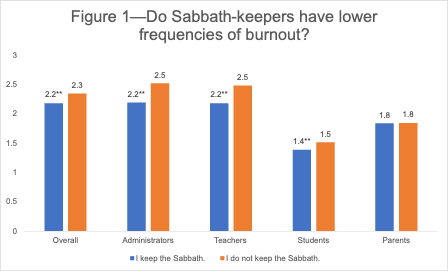
Our first finding was that Sabbath practices are strongly and positively associated with mental wellness. There is a significantly lower burnout rate between those who practice Sabbath-keeping with those who do not practice Sabbath-keeping. This trend is observed in almost all categories of school constituents (see Figure 1). Our finding affirms a biblical truth that needs no empirical proof: we are created not only for work but for rest, bearing the image of our Heavenly Father, who in six days made the heavens and the earth and rested on the seventh day.

burnout frequencies

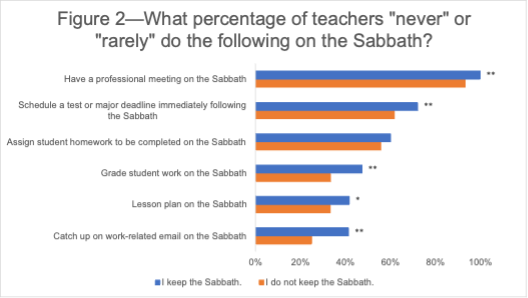
Differences between individuals who “keep the Sabbath” and those who claim they do not may provide us with hints as to why we see differential levels of burnout. Teachers who keep Sabbath practices have a lower likelihood than their counterparts in engaging in school-related work on the Sabbath (see Figure 2).

teachers and sabbath

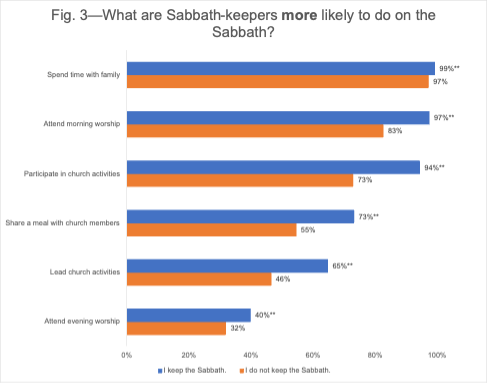
If Sabbath-keepers are more likely to avoid work-related activities on the Sabbath, how do they spend their Sabbaths? Sabbath-keepers are more likely to engage in church-related activities, including fellowship with their family and other church members on the Sabbath (see Figure 3).

teachers and sabbath practices

Implications of the Findings

The COVID-19 pandemic has underscored the importance of setting aside time to rest and pause. This truth also applies to Christian school communities. Our findings confirm that the act of resting through Sabbath practices make a difference in one’s wellness. More importantly, we know that observing the Sabbath through rest is an act of worshipful obedience to God, the Creator, and Sustainer of our lives and everything in the world.

Based on our findings, schools may want to prayerfully consider some of the following strategies:

  1. Think about your school’s main priorities. Might there be a tension between pursuing excellence and promoting Sabbath practices?
  2. School leaders may find it helpful to explicitly communicate any guidance or policies around setting aside the Sabbath day for their teachers and staff. At the same time, it is important to consider whether we are creating working environments that make it manageable for teachers to take Sabbath rest.
  3. Teachers should be thoughtful about how their classroom policies may create opportunities for students to remember the Sabbath. A good question to ask is whether we are shepherding students to develop spiritual disciplines, including Sabbath practices.